A Critical and Collaborative Shift of Perspectives within the Highland Boundary Fault Zone
Downloads
DOI:
https://doi.org/10.47982/spool.2025.2.02Published
Issue
Section
Categories


How to Cite
Keywords:
Astonishment, critical zones, interdimensional representations, landscape perception, shifting scalesAbstract
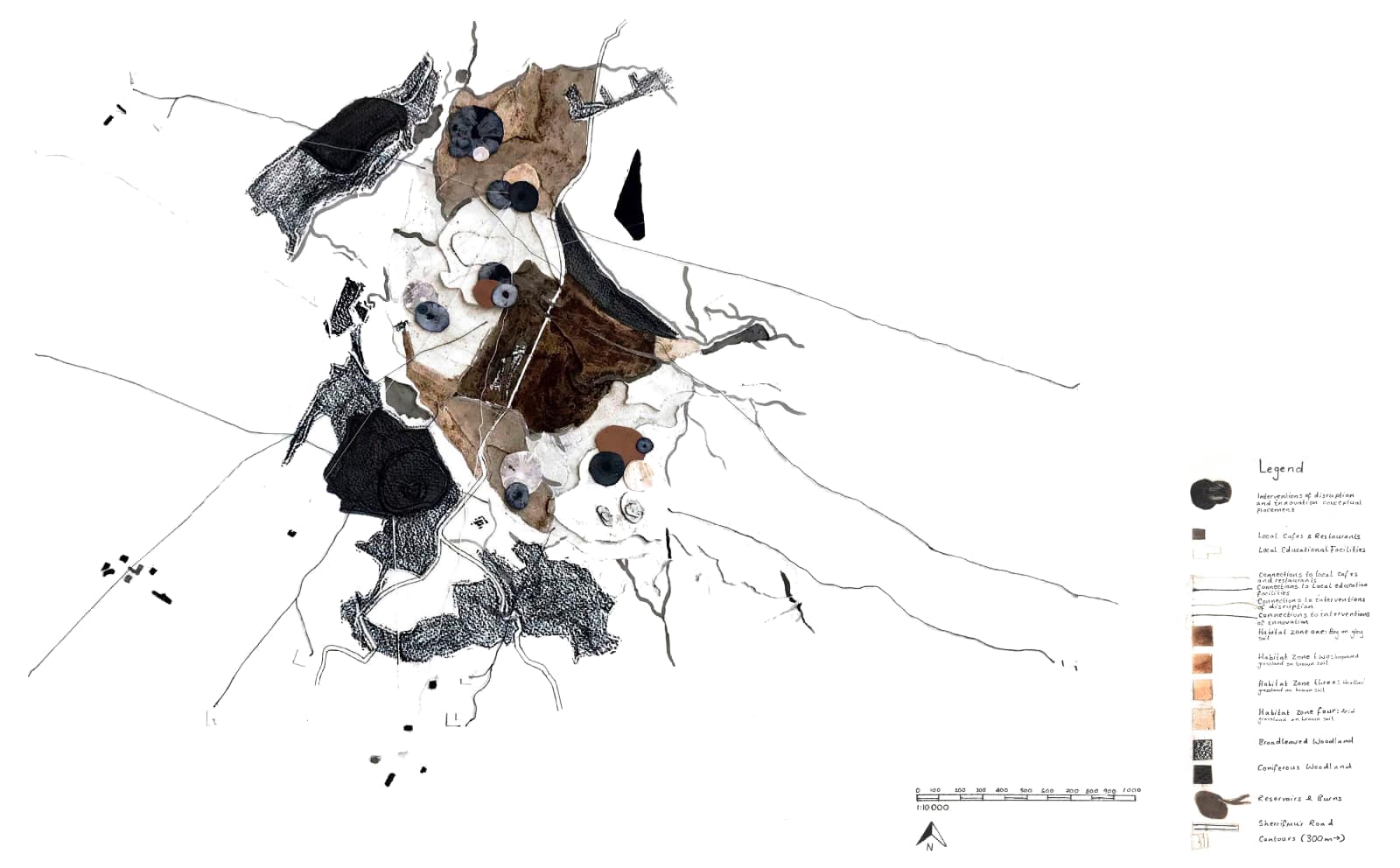
This visual essay explores the translation of complex environments through representations with attributes that are summarized as ‘interdimensional’. These attributes are not yet elaborated, but the term emphasizes that these representations integrate different dimensions of experiencing and understanding various spatial scales and temporal perspectives. The process of producing these representations requires the Landscape Architect to encounter, investigate, and communicate life, materiality, and processes in an approach that values attentiveness and creativity.
The representations discussed were developed in the context of a design studio at the University of Edinburgh, which was elaborated and led by the author and situated within the Highland Boundary Fault Zone in Scotland. A studio collective, composed of Master’s students in landscape architecture over two years, was encouraged to traverse the fault zone, taking into account social, ecological, and geological fractures, as well as points of tension and upheaval.
Operating from within the ‘critical zone’, the late Bruno Latour’s and his collaborators’ provocation has been adopted: that working from this perspective is necessary to recognize that we humans are ‘living among the living’ (Société d’Objets Cartographiques [SOC], 2018). The author’s, and the design studio’s approach encourages experimental drawing and making to develop ‘ecologically explicit’ landscape architecture—landscape interpretations and design propositions—that foreground and support more-than-human worlds.
Downloads
References
Bjornerud, M. (2018). Timefulness How Thinking Like a Geologist Can Help Save the World. Princeton University Press. DOI: https://doi.org/10.2307/j.ctvc772cs
The University of Edinburgh. (2024.10). Drumbrae | Social Responsibility and Sustainability. https://www.ed.ac.uk/sustainability/programmes-and-projects/climate-strategy/carbon-sequestration/drumbrae
Haraway, D. (2016). Staying with the Trouble: Making Kin in the Chthulucene. Duke University Press. DOI: https://doi.org/10.2307/j.ctv11cw25q
Morton, T. (2021). All art is ecological. Penguin Books.
Société d’Objets Cartographiques, [SOC]. (2018). Inside. http://s-o-c.fr/index.php/2018/02/20/inside-2/


